
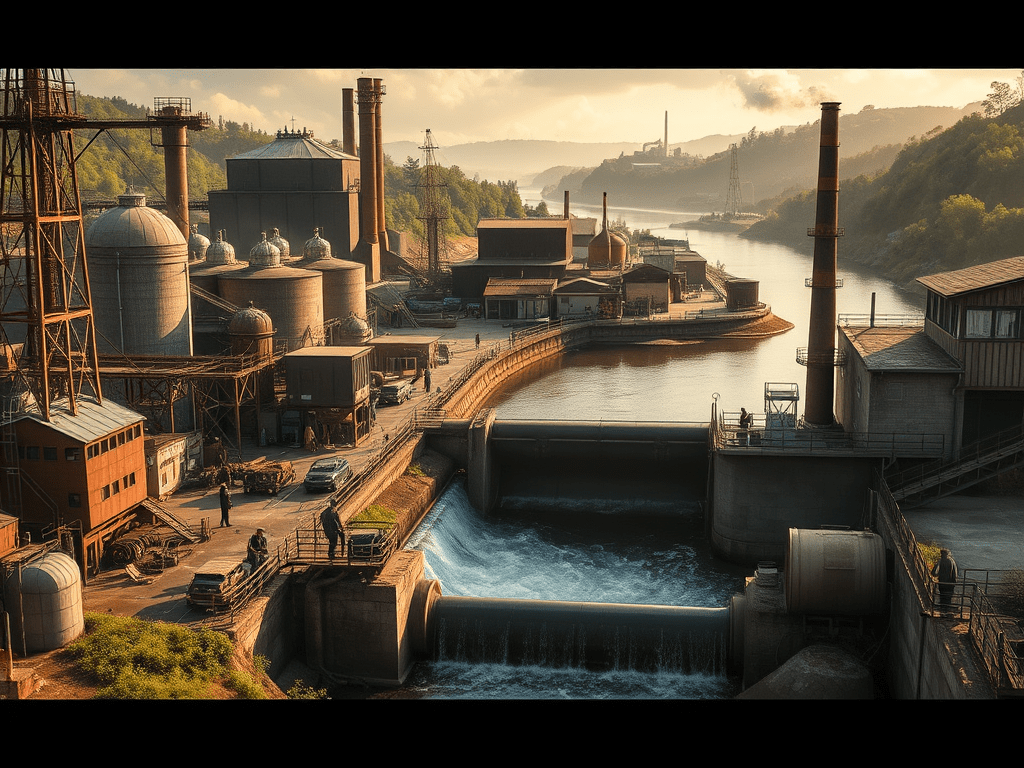
Historians have widely documented how businesses, industries and trades working on large and small scales have influenced human and planetary health and the environment. These impacts, both positively and negatively, were often mediated through the flows of water. On the one hand, businesses and trades played a key role in providing clean drinking water, thereby improving public health. On the other, industries from mines and chemicals to nuclear plants and microchips exploited clean water and discharged wastewater that polluted soils, rivers, and lakes.
In tracing and identifying the industries, trades, and sometimes individual businesses and corporations responsible for these ecological impacts, historians have – in their focus on the overall outcomes – traditionally approached these businesses as large “black boxes”, as homogenous entities, while their internal dynamics tend to be overlooked. As a result, less attention has been given to the specific technologies that contributed to environmental changes, the expertise of the professionals who mediated the relationship between business and water, or the organizational structures that facilitated these processes. In this panel for the European Business History Association (EBHA)’s conference on business history and sustainability challenges, held in Brussels from 26th to 28th June 2025, we propose to disentangle and compare the internal dynamics of businesses with a health/environmental impact on or through water.
- Contributions may examine a broad range of industries and trades that mediated or affected health and the environment, ranging from textile factories on the riverfront, water distribution companies, artisans working with water, to enterprises building or maintaining hydraulic infrastructures (dams, sewers, canals), etc.
- Additional perspectives may involve the varied range of interactions between these businesses’ internal dynamics and external factors, such as government regulations, the neighbours, workers, clients and others affected by the businesses’ environmental impact, the agency of rivers and water flows themselves, and the ways in which the internal dynamics of businesses were both shaped by and in themselves shaped broader socio-economic features and developments that characterized the rise of capitalism and the Capitalocene.
- We invite contributions from around the world, particularly welcoming those applying a comparative approach and/or a perspective on the Global South, including the environmental impact of business, trade and industry in imperial and colonial contexts.
- We also aim to provide a long-term perspective on these dynamics. We are open to contributions from all historical periods. The environmental impact of business and trade, as well as water management practices, were not exclusive to the rise of modern corporations; they also existed in less hierarchical, informal, small-scale, artisanal, and other forms of production and trade.
Proposals can be submitted until January 12, 2025 via email to matthijs.degraeve@vub.be and laurent.beduneau-wang@um6p.ma. They should consist of a title, an abstract of max. 350 words, your affiliation and a short bio (max. 250 words). Accepted proposals will be included in a joint panel submission for EBHA, which notifies of acceptance by March 31st. Additional information and guidelines can be found in EBHA’s general call for papers: https://ebha.org/files/1/CFP_EBHA_Brussels_2025.pdf
Organisers:
Matthijs Degraeve, postdoctoral researcher, FWO/Vrije Universiteit Brussel, Belgium
Laurent Béduneau-Wang, assistant-professor, Africa Business School (ABS), University Mohammed VI Polytechnic (UM6P), Morocco
 ARiSE
ARiSE 